
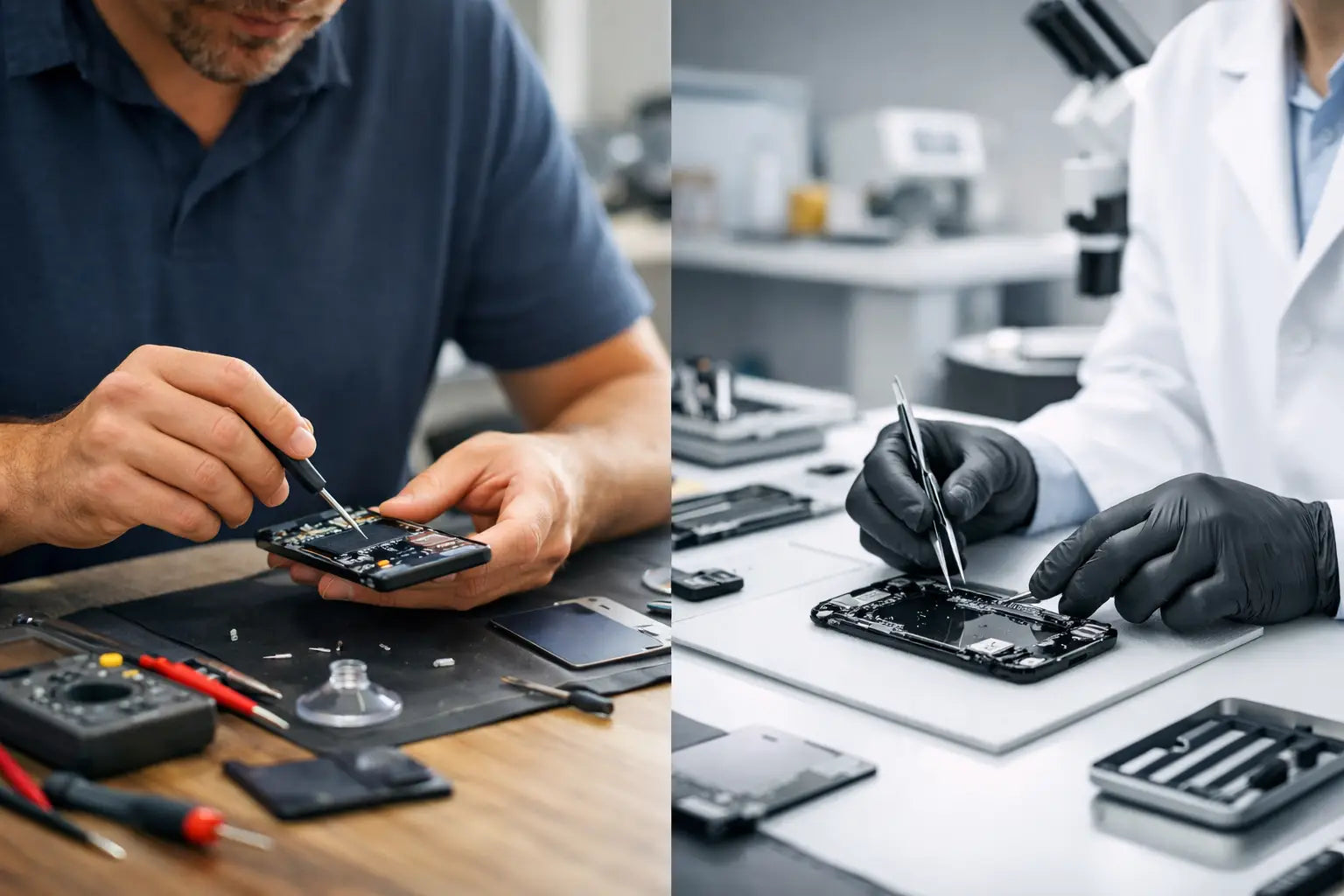
Your phone screen cracks on a Tuesday morning, your laptop stops charging before a deadline, or your tablet gives up just before a family trip. That is when the question gets real: third party repair versus brand repair. Most people are not looking for a theory lesson at that point. They want to know who can fix the device properly, how much it will cost, and how quickly they can get back to normal.
The honest answer is that both options can make sense. It depends on the device, the fault, your budget, and whether speed matters more than sticking strictly with the original brand. If you know the trade-offs before you book anything, you are far less likely to overpay or end up waiting longer than necessary.
Third party repair versus brand repair: what is the difference?
Brand repair usually means sending your device to the manufacturer or using its official repair network. That often gives customers peace of mind because the repair follows the brand's own process, with approved parts and warranty rules.
Third party repair means using an independent repair shop instead. That might sound like the less formal option, but a good independent repair business can still offer experienced technicians, quality replacement parts, clear quotes, and much faster turnaround.
The real difference is not simply official versus unofficial. It is about how each route handles price, waiting time, parts availability, diagnostics, and flexibility.
Cost is often the first deciding factor
For many customers, brand repair is the most expensive option. That is especially true for out-of-warranty devices. A manufacturer may charge a flat repair fee that makes sense on a newer premium device, but feels hard to justify on an older phone, tablet, or laptop.
Third party repair is often more budget-friendly. Independent shops can usually price common repairs more competitively, especially for screen replacements, charging port repairs, battery changes, camera issues, and smaller component faults. That matters if your device still has a few good years left in it and you simply want it working again without spending close to replacement cost.
That said, cheaper is not always better. If a quote seems unusually low, ask what is included. The quality of parts, the testing process, and any repair warranty all affect value. A good repair should save you money, not create a second problem a week later.
Speed matters more than most people expect
People often assume the official route is the safest, but forget how disruptive delays can be. If your phone is your bank app, camera, map, ticket wallet, and work contact point all in one, being without it for days or weeks is not a small inconvenience.
This is where independent repair can be the better fit. A third party repair shop may have common parts in stock and be able to complete repairs much faster. For everyday faults, that can mean same-day or next-day service rather than packaging the device, sending it away, waiting for assessment, and then waiting again for return.
Brand repair can still be worth the wait for some customers, particularly if the device is under manufacturer warranty or part of a repair programme. But if your main concern is getting back up and running quickly, third party usually has the advantage.
Parts quality is where people get cautious
This is the part that causes the most hesitation, and fairly enough. Customers want to know whether the replacement part will perform properly and whether the repair will hold up.
With brand repair, the attraction is obvious. You are more likely to get original parts fitted through the brand's approved channels. That can be important on high-end devices where screen quality, battery communication, or software pairing matters.
With third party repair, parts can vary. Some independent repairers use high-quality compatible parts, while others may offer different grades depending on your budget. That is not automatically a bad thing. In fact, having options can be useful. Not every customer wants to pay top-level pricing for an older device that has already had a few years of wear.
The key is transparency. A repair shop should explain what type of part is being used, how it compares with the original, and what guarantee comes with it. If that information is vague, keep asking.
Warranty can change the right choice
If your device is still under manufacturer warranty, brand repair often makes the most sense. Using the official route can help protect that cover and avoid disputes later if another issue appears.
If the device is already out of warranty, the decision becomes more open. At that point, paying a premium purely for the brand name may not be the smartest move, especially if the fault is straightforward and a trusted repair shop can handle it well.
There is also a middle ground that people miss. Some customers assume any third party repair means no protection at all. In reality, many independent repair businesses provide their own warranty on the work carried out. It is not the same as a manufacturer warranty, but it still gives you reassurance that the repair is backed up.
Third party repair versus brand repair for common faults
For a cracked screen, worn battery, faulty charging port, damaged back glass, or camera issue, third party repair is often the practical choice. These are common faults, and an experienced independent technician sees them every day. The repair can often be done faster, for less money, and without the admin that comes with manufacturer channels.
For complex board-level issues, software locks tied to official systems, or faults affecting very new premium models, brand repair can have the edge. Some manufacturers restrict access to certain tools, calibrations, or components, which can make official service the better route.
For laptops and computers, the picture is mixed. Brand support can be useful for machines with active coverage, but independent repair can be especially valuable for older devices where the brand may push replacement over repair. A good technician may be able to replace a battery, charging socket, keyboard, screen, fan, or storage drive at a much more sensible cost.
Convenience is not a small detail
A lot of repair decisions come down to how much hassle you can tolerate. Brand repair can involve online forms, account checks, postage, assessment delays, and limited flexibility. That may be fine if you have a backup device and plenty of patience.
Independent repair shops tend to be more direct. You can ask questions, get a quote, check part availability, and sort the issue without going through layers of support scripts. For customers around Celbridge and across Ireland who want a straightforward answer, that convenience matters just as much as price.
That is one reason businesses like First Help Tech appeal to practical customers. If you can sort a repair, pick up a charger, replace a case, and get advice on protecting the device next time, it saves time as well as money.
How to choose without guessing
Start with three questions. Is the device still under manufacturer warranty? Is the repair cost reasonable compared with replacing the device? And how quickly do you need it back?
If the device is covered and the fault may qualify, brand repair is usually the safer first step. If it is out of warranty and the issue is common, a reputable third party repairer is often the smarter value choice.
Then look at the shop, not just the headline price. Ask whether the part is original or compatible, what warranty is included on the repair, how long it will take, and whether the device will be fully tested before return. Reviews matter too, especially for local repair businesses. Customers tend to be very clear when a shop is fast, fair, and reliable.
Finally, think about the age of the device. Spending heavily on official repair for an older model does not always add up. A cost-effective independent repair can give it another year or two of useful life, which is often exactly what people need.
The better option is the one that fits your situation
There is no universal winner in third party repair versus brand repair. Brand repair offers official processes, warranty alignment, and reassurance for newer devices. Third party repair often wins on speed, affordability, flexibility, and common-sense value.
The best choice is the one that matches the device in front of you, not the one that sounds best in theory. If a repair is explained clearly, priced fairly, and done properly, that is what matters most. A broken device is stressful enough without paying extra for confusion.
Before you hand anything over, ask the plain questions and expect plain answers. A good repair service should make that easy.