
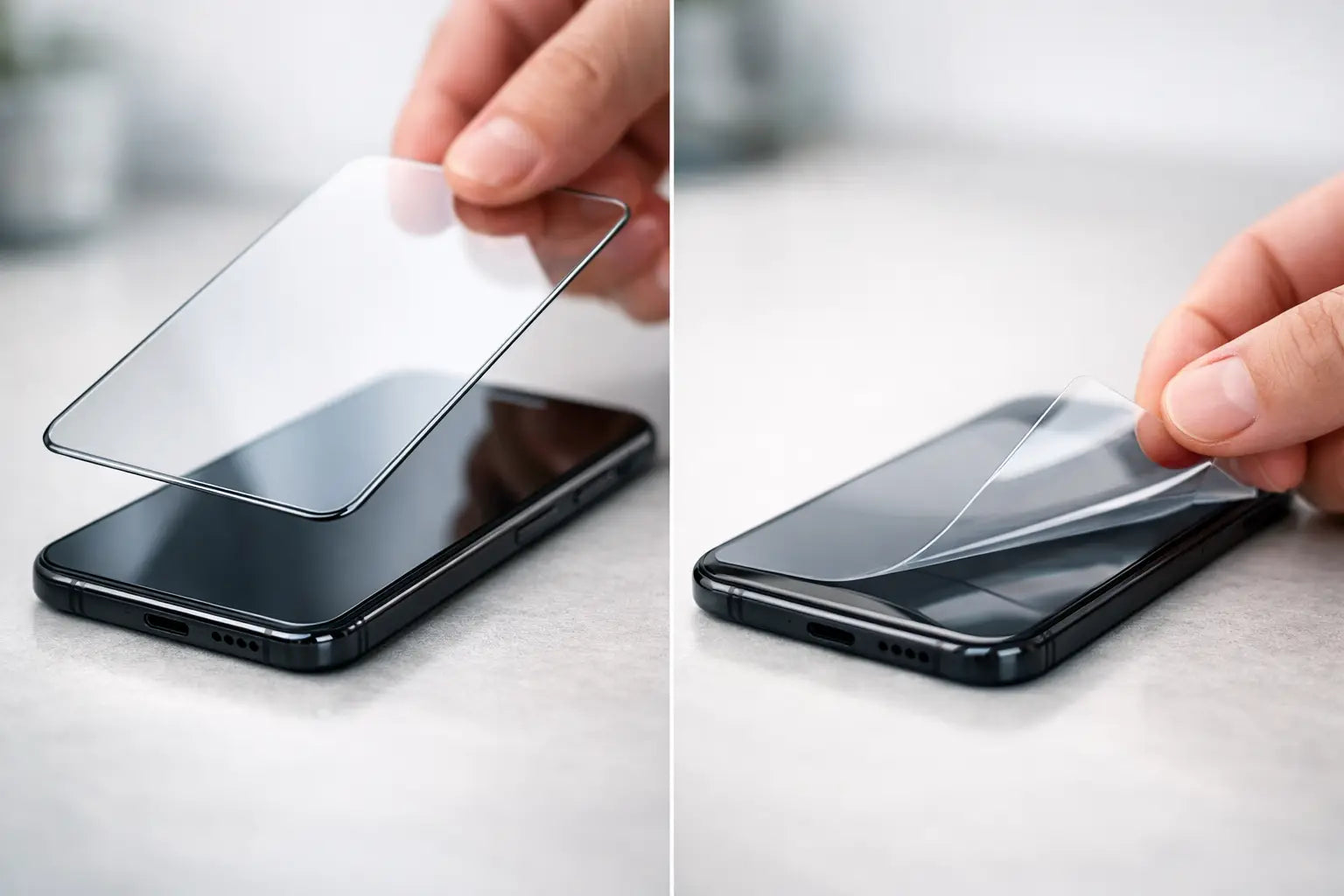
You only notice a screen protector when it annoys you - bubbling at the corners, catching your thumb, or failing after the first drop. That is why the tempered glass vs film question matters more than it sounds. The right choice can keep your phone easier to use, cheaper to maintain, and far less likely to need a full screen repair.
For most people, this is not really about specs. It is about daily use. If your phone lives in a pocket with keys, gets passed to kids in the back seat, or spends half the day on a worktop beside a mug of tea, your protector needs to suit real life, not just the product listing.
Tempered glass vs film at a glance
Tempered glass protectors are made from reinforced glass and are designed to feel close to your original screen. Film protectors are usually made from plastic, often PET or TPU, and sit as a thinner layer over the display. Both aim to reduce scratches and wear, but they do the job in different ways.
Tempered glass is usually the better pick if you want a more solid feel, stronger impact resistance, and easier fitting. Film is often chosen for lower cost, slimmer coverage, or better compatibility with curved displays. Neither is automatically right for everyone, and that is where many buyers get caught out.
What tempered glass does well
The biggest advantage of tempered glass is protection against impact. If your phone drops face-down onto a hard floor, glass gives you a better chance of avoiding direct damage to the screen underneath. It works by taking the hit itself. In many cases, the protector cracks and the display survives.
It also feels better to use. That matters more than people expect. A decent tempered glass protector is smooth, responsive, and closer to the original touch experience. Scrolling, tapping, and typing tend to feel more natural, especially on newer phones where screen quality is a big part of the appeal.
There is also the fitting side of it. Glass protectors are generally easier to align because they are rigid. You place them, line them up, and lower them into position. Film is less forgiving. It can stretch slightly, trap dust more easily, and show small mistakes more clearly.
For customers who want something practical and low-fuss, tempered glass is often the safer buy.
Where film still makes sense
Film protectors are not outdated. They simply suit different priorities.
The main benefit is flexibility. On phones with curved edges, film can sometimes provide better edge coverage because it bends where glass cannot. If you use a case that pushes against the sides of a protector, film may also be less likely to lift.
It is usually cheaper too. If your goal is basic scratch protection rather than drop protection, film can do the job without costing much. That makes it a reasonable option for older phones, secondary devices, children’s devices, or anyone trying to keep costs down.
Some film protectors also have self-healing properties for light surface marks. That does not mean deep scratches vanish, but minor scuffs can become less visible over time. For a phone that stays mostly in a bag or on a desk, that may be enough.
Tempered glass vs film for drops and scratches
If you are comparing pure durability, tempered glass usually wins for drops and film usually covers the basics for scratches.
That difference matters because scratches and cracks are not the same problem. Film can help stop your screen picking up everyday marks from coins, keys, or grit in a pocket. What it does not do as well is absorb the force of a direct impact. When the phone lands badly, film offers less of a barrier.
Tempered glass gives you a stronger sacrificial layer. It can still break, and sometimes quite dramatically, but that is often the point. Replacing a cracked protector is much easier and cheaper than replacing the whole display.
If you are clumsy, commute a lot, work on the move, or hand your phone around the family, glass is usually worth the extra a few euros.
How each one feels in daily use
Feel is where opinions become strong very quickly. A lot of people who switch from film to tempered glass do not want to go back.
Glass tends to feel smoother under the finger. It is less draggy, more like the actual display, and often clearer to look through. If you spend hours each day messaging, browsing, banking, or watching video, that can make the phone feel better every single time you pick it up.
Film can feel slightly softer or tackier depending on the material. Some people do not mind that. Others notice it straight away. Visibility can also vary. Lower-quality film protectors may reduce sharpness a little or show wear faster, especially if they pick up small scratches across the surface.
That said, not all film is poor and not all glass is premium. Quality matters on both sides. A badly made tempered glass protector with weak adhesive or poor cut-outs can be just as frustrating as a cheap film that never sits properly.
Case compatibility and curved screens
This is one of the most overlooked parts of the tempered glass vs film decision.
A phone case and a screen protector need to work together. Some full-cover glass protectors sit very close to the edge of the display. Add a tight case and the protector can start lifting at the corners. Once that happens, dust gets in and the protector usually needs replacing.
Film can be easier on curved or edge-to-edge screens because it flexes with the shape. It may not feel as premium, but it can offer a neater fit where glass struggles. If you already have a heavy-duty case you like, check compatibility before buying a protector based on price alone.
For many newer phones, especially those with more complex screen shapes, the best option depends on the exact model. This is where getting the right fit matters more than arguing over materials in general.
Which is better value?
At first glance, film looks like the cheaper option and sometimes it is. But value is not only about the purchase price.
If you fit a film protector twice because the first one trapped dust, or if you replace it regularly because it scratches quickly, the savings can disappear. Tempered glass costs more upfront, but many buyers find it lasts longer and gives better peace of mind.
Still, there are cases where spending less is sensible. If your phone is older, if you are planning to upgrade soon, or if you mainly want to stop light scratches, a film protector may be all you need. There is no point paying for impact protection you do not value.
A practical rule is this: if replacing your phone screen would be a real hassle financially or logistically, tempered glass is usually the smarter buy.
Who should choose tempered glass?
Tempered glass is the better fit for most users who want simple, strong everyday protection. It suits people who drop their phone now and then, use their device constantly, or care about keeping the screen feeling close to original. It is also a good choice if you want straightforward fitting and less trial and error.
Students, busy parents, delivery drivers, office workers, and anyone who relies on their phone for work and personal life usually benefit more from glass. When your phone is central to the day, better protection tends to pay for itself.
Who should choose film?
Film makes more sense if budget is the main concern, if your phone has a screen shape that does not pair well with glass, or if your priority is thin, light scratch protection rather than impact resistance. It can also suit lower-risk use, such as a backup handset or a tablet that mostly stays indoors.
If you are careful with your device, use a solid case, and rarely drop it, film may be perfectly adequate. It is not the premium option in most situations, but it can still be the sensible one.
The better choice depends on your phone habits
For the average smartphone user, tempered glass is usually the better all-round option. It protects better against drops, feels nicer to use, and is often easier to install cleanly. Film still has a place, especially for curved screens, tighter budgets, and light-use devices.
If you are unsure, think less about the packaging and more about how you actually use your phone. A protector should match your routine, your case, and your budget. Get that part right and your screen stays one less thing to worry about.