
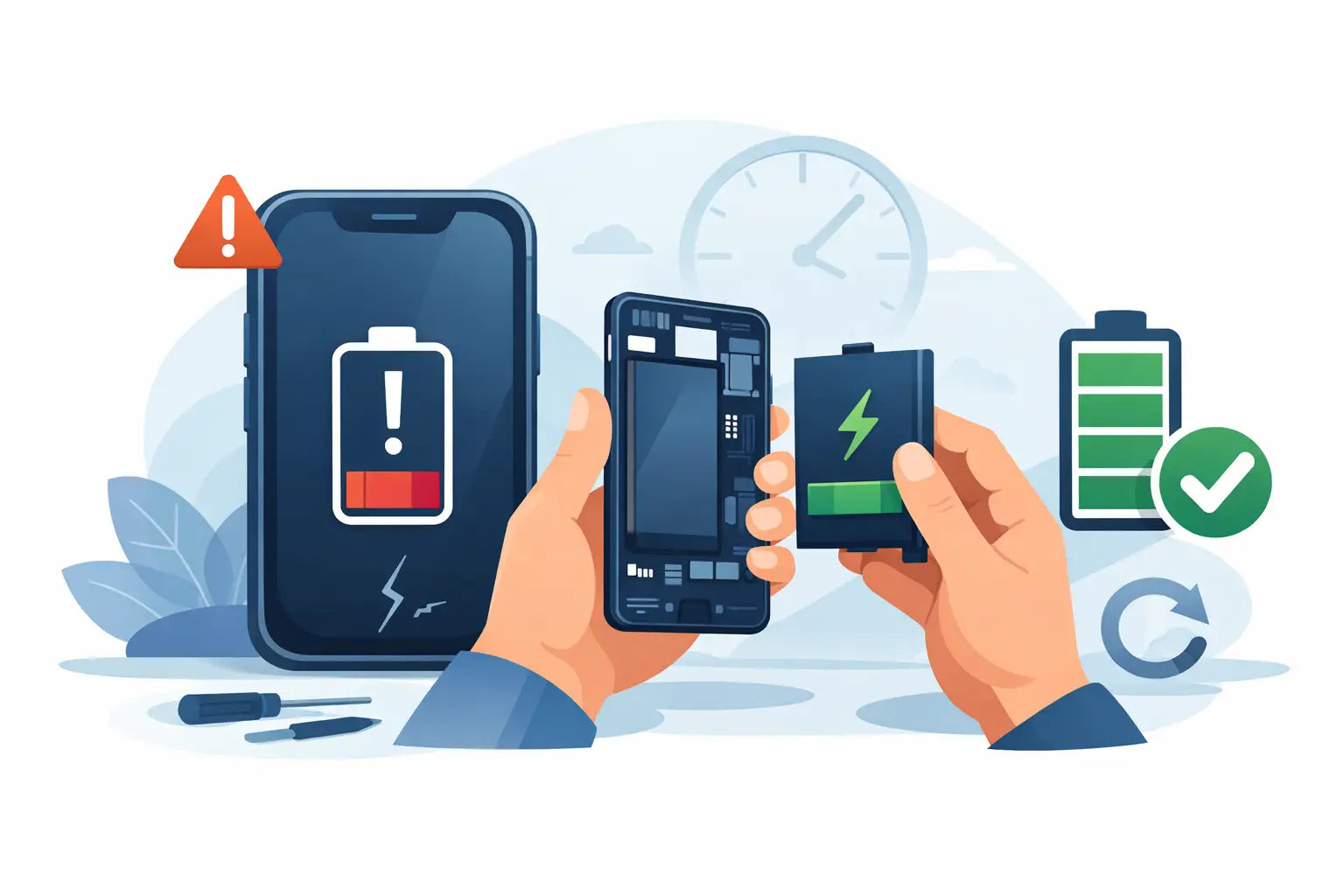
You usually notice it on a day when you actually need your phone. It drops from 28% to 9% in minutes, switches off in the cold, or needs a charge before dinner even though you topped it up that morning. If you are wondering when should phone battery be replaced, the short answer is this: replace it when the battery no longer gets you through normal daily use, or when it starts affecting how safely and reliably the phone works.
That sounds simple, but in real life it depends on the age of the device, the condition of the battery, and whether the rest of the phone is still worth keeping. A battery is a consumable part. It wears out over time, just like tyres or brake pads. The trick is knowing the difference between a battery that is naturally ageing and a phone that has another fault.
When should phone battery be replaced in real life?
Most phone batteries start to show their age after around two to three years of regular use. That does not mean every battery fails at the same point. Some users charge little and often, keep their device cool, and get longer life. Others use navigation, video, gaming, mobile data and fast charging every day, which can wear the battery more quickly.
A good rule is to look at what has changed. If your phone used to last the full day and now struggles for a few hours, that is a strong sign the battery capacity has dropped. If you are carrying a charger everywhere, changing settings constantly, or avoiding leaving the house on low charge because you do not trust the phone, the battery is already affecting daily use.
Battery replacement also becomes the right move when the phone itself is still doing the job. If the screen is fine, the cameras work, and performance is good enough for what you need, replacing the battery is often much better value than replacing the whole handset.
The signs your phone battery is worn out
Poor battery life is the obvious one, but it is not the only clue. A worn battery often causes a mix of symptoms rather than one single issue.
If the percentage jumps up or down suddenly, the battery may no longer be measuring charge properly. If the phone powers off at 15% or 20%, especially under load, the battery may not be able to deliver stable power anymore. You might also notice the phone getting unusually warm during ordinary tasks, taking longer to charge, or feeling sluggish because the system is managing around a weak battery.
Swelling is the one sign you should never ignore. If the screen is lifting, the back cover is separating, or the phone feels warped, stop using it and get it checked straight away. A swollen battery is not just worn out. It is a safety issue.
Battery health numbers matter, but not on their own
Some phones give you a battery health reading in settings. This can be useful, but it should not be treated as the whole story. If a battery health reading has dropped below 80%, replacement is usually worth considering. That is the point where many people begin to notice shorter usage time and less consistent performance.
Still, the number should match your real experience. A phone on 82% health that dies by lunchtime may need a new battery. Another on 79% might still be manageable for someone with light use. The reading is a guide, not a final verdict.
On devices without a clear battery health menu, the everyday signs matter more. Frequent charging, unexpected shutdowns and rapid drain tell you plenty.
When a battery replacement is worth the money
The best time to replace a phone battery is before the battery makes the phone frustrating to use but while the rest of the device is still worth saving. That middle ground is where you get the best value.
For example, if your phone is two or three years old, works well, and only needs better battery life, replacing the battery is usually a sensible spend. It is a much smaller cost than buying a new device, and it can give the phone another year or two of useful life.
If the phone is already badly cracked, struggling with updates, or has several faults at once, the decision changes. In that case, it may be smarter to put the money towards a replacement device instead of fixing one problem on an ageing handset.
This is where a quick quote helps. You do not need to guess whether the repair makes sense. Compare the battery replacement cost against the value and condition of the phone you already have.
Common battery problems that are not always battery failure
Not every battery complaint means the battery itself is finished. Sometimes the issue is charging habits, software, or another hardware fault.
A worn charging cable or plug can make charging seem erratic. Background apps, poor signal, constant Bluetooth use and high screen brightness can drain power much faster than expected. After a software update, a phone may also behave oddly for a day or two while apps settle and indexing completes.
Charging port faults can also look like battery trouble. If the phone only charges at a certain angle, charges very slowly, or disconnects easily, the port may be the real issue. That is why a proper check matters. Replacing the wrong part wastes time and money.
Heat, cold and fast charging
Temperature has a big effect on batteries. Cold weather can make a weak battery shut down earlier than expected, while excessive heat speeds up battery wear over time. Leaving a phone in a hot car, gaming while charging, or using cheap unreliable chargers can all shorten battery life.
Fast charging is convenient, and for most people it is fine, but heat is still the real enemy. If your phone is regularly getting very hot, that is harder on the battery than charging speed on its own.
Should you keep using a power bank instead?
A power bank can help, but it should not become a permanent workaround for a battery that is clearly failing. If you need backup power for travel, work shifts or long commutes, that is normal. If you need it just to get through an ordinary day because the phone cannot hold charge anymore, the battery is telling you something.
There is also the convenience factor. A phone with a healthy battery is easier to rely on. You are not hunting for sockets, carrying extra cables, or watching the percentage all day. For most people, that daily hassle is the real tipping point.
When should phone battery be replaced instead of the whole phone?
This comes down to cost, condition and how you use your device. If your phone still meets your needs for calls, banking, photos, school runs, work messages and everyday apps, a battery replacement is often the practical choice. It is especially good value if you want to avoid the higher cost of a new handset and the hassle of moving everything over.
If you are already planning to upgrade because the phone is too slow, storage is full, or software support is ending, battery replacement may only delay the inevitable. There is no point spending on a battery if you will replace the phone next month anyway.
A lot of customers sit somewhere in the middle. They are not chasing the newest model. They just want their current phone to last properly again. In those cases, a battery replacement is often the most affordable fix.
A simple way to decide
Ask yourself three things. Does the battery last long enough for a normal day? Is the phone shutting down, overheating, swelling or behaving unpredictably? Is the rest of the phone still worth keeping?
If the answer is no, yes and yes, battery replacement usually makes sense.
If you are still unsure, get the device checked before the problem gets worse. A quick assessment can confirm whether it is the battery, the charging port or something else, and that makes the next step much easier.
For people around Ireland who want to keep their device going without spending a fortune, that is often the smartest route. A good battery should make your phone feel dependable again, and when your phone stops feeling dependable, that is usually the moment to act. If your handset is still useful, a fresh battery can be the simplest way to get a lot more life out of it.