
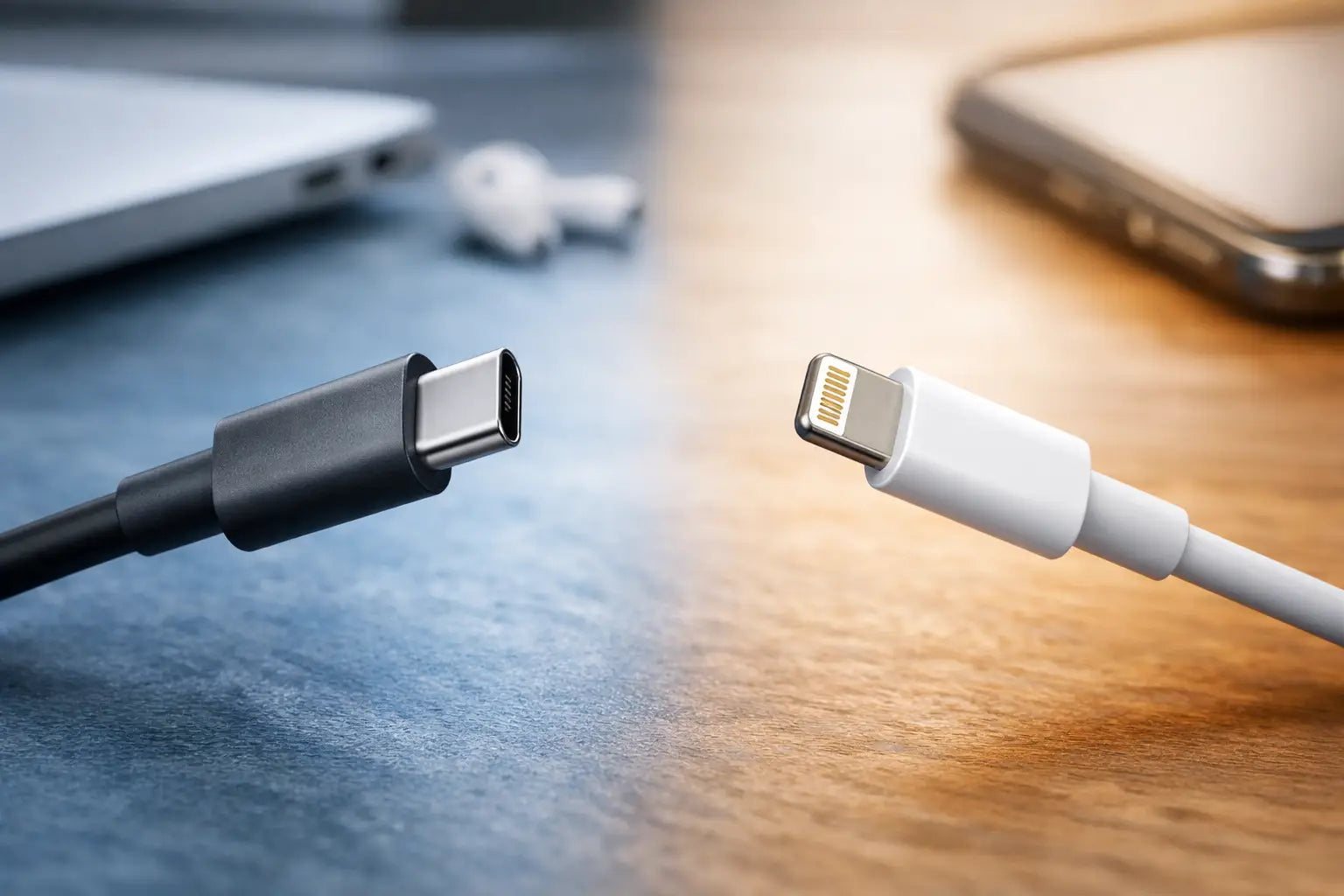
You usually notice the difference between cables when one stops charging at the worst possible time. That is where the usb c vs lightning cables question becomes less about tech specs and more about what actually works for your phone, tablet, car charger, power bank, and daily routine.
If you are buying a replacement cable, the right choice depends on the device in your hand first, and the way you use it second. One cable is not automatically better in every case. It comes down to compatibility, charging speed, durability, and whether you want something that will still suit your setup a year from now.
USB C vs Lightning cables at a glance
Lightning is Apple’s older charging and data connector. For years, it was standard on iPhones, many iPads, AirPods cases, and a wide range of Apple accessories. If you have an older iPhone, there is a good chance Lightning is still the cable you need.
USB-C is now the newer standard across most modern devices. Android phones have used it for years, and Apple has moved many iPads, MacBooks, and newer iPhone models to USB-C as well. That shift matters because it makes charging simpler across brands and device types.
In plain terms, Lightning is still useful if your device requires it. USB-C is generally the more future-friendly option if your device supports it.
Compatibility matters more than hype
The biggest mistake people make is buying based on what seems newer rather than what actually fits. A cable only helps if it matches your device and charger properly.
If you have an iPhone 14 or older, you are likely using Lightning. If you have an iPhone 15 series or newer, you are using USB-C. Many households now have a mix of both, which is why cable confusion is common. One person has an older iPhone, someone else has a newer iPad, and the laptop, earbuds, and power bank all use something different.
That is where a bit of planning saves money. If most of your devices are already on USB-C, it often makes sense to keep moving in that direction when upgrading. If your phone and accessories still use Lightning, there is no point forcing a change before the device itself changes.
Charging speed - where USB-C usually pulls ahead
When people compare usb c vs lightning cables, charging speed is often the first thing they ask about. Fair enough - nobody wants to wait around for a battery to crawl back to 20 per cent.
USB-C usually offers faster charging, especially when paired with a suitable fast charger and a device designed to accept higher power input. That is one of the main reasons it has become the standard on newer phones, tablets, and laptops. It is simply better suited to modern charging demands.
Lightning can still charge perfectly well for everyday use, but it generally has lower limits. For older iPhones, that may not be a problem. If your phone was built around Lightning, you are not missing out on some magical performance jump by buying a more expensive Lightning cable. What matters is getting a reliable cable with proper power support, rather than the cheapest one in the basket.
Charging speed also depends on more than the cable. The plug, the device, and even the condition of the charging port all play a part. If your phone charges slowly no matter what cable you use, the issue may be wear in the port, a weak adapter, or battery health rather than the cable itself.
Data transfer and everyday convenience
Cables do more than charge. People still use them to transfer photos, back up devices, connect to laptops, or run CarPlay and other in-car systems.
USB-C tends to offer better data performance overall, especially on devices designed to use higher transfer standards. That is useful if you regularly move large files or use accessories that depend on stable wired connections. For most casual users, though, this is not the deciding factor. If you mainly charge your phone overnight and sync the odd file, either cable does the job the device was made for.
Convenience is really where USB-C starts to win for many buyers. A single cable type can often charge your phone, tablet, wireless earbuds, handheld console, and laptop accessories. Fewer cable types means less clutter and fewer last-minute scrambles before work, college, or travel.
Durability - not all cables are built the same
A lot of people blame the connector type when the real problem is cable quality. Both USB-C and Lightning cables can fail early if they are cheaply made, bent sharply near the ends, or stuffed into bags every day without any protection.
That said, some users find Lightning connectors feel a bit more delicate over time, especially with heavy daily use. USB-C connectors are generally seen as more durable and better suited to repeated plugging and unplugging. But build quality matters more than connector shape on its own.
If you want a cable that lasts, look for strong strain relief near the connector, decent outer braiding or reinforced coating, and a secure fit in the port. A cable that feels loose from day one is rarely a good sign. It is often worth paying a little more for one that survives daily use, rather than replacing a bargain cable every few weeks.
Which cable is better for iPhone users?
This is where the answer gets simple. If your iPhone has a Lightning port, buy a Lightning cable. If your iPhone has a USB-C port, buy a USB-C cable. The better question is really what else you want that cable to work with.
If you are on a newer iPhone and already use USB-C for other devices, switching fully to USB-C makes life easier. You can keep fewer chargers around the house, in the car, or at work. If you are still on an older iPhone, sticking with a good Lightning cable is the practical move until you upgrade.
For families, mixed-device setups are common. In that case, having both cable types at home is not wasteful - it is realistic. One cable by the sofa, one in the car, one spare in a bag. That is usually more useful than trying to force one charging standard into every situation.
USB C vs Lightning cables for cars, power banks and travel
Travel is where cable choices become very obvious, very quickly. If you are packing for a weekend away or trying to keep devices charged during a commute, you want fewer accessories, not more.
USB-C is better for people who carry multiple devices and want one cable to cover most of them. Many newer power banks, wall chargers, and car chargers are built around USB-C output. That can make charging faster and more straightforward.
Lightning still makes sense if your main device depends on it, especially if you use Apple accessories that have not yet moved over. But if you are buying a new charger setup and your current or next phone supports USB-C, it is usually the smarter long-term choice.
For anyone replacing worn accessories, this is often the point where standardising starts to pay off. A good-quality USB-C cable can reduce the pile of random leads in drawers, glove boxes, and desk organisers.
Price and value - cheaper is not always cheaper
It is tempting to buy the lowest-priced cable available, especially if you need one quickly. Sometimes that works out. Quite often, it does not.
Cheap cables can charge slowly, lose connection, overheat, or fail at the connector after light use. That means buying again, sometimes more than once. A better-made cable usually gives better value over time, even if the price is higher at the start.
For most people, the sweet spot is a well-made cable from a trusted electronics supplier rather than the absolute cheapest option or the most overhyped premium one. You want something reliable, safe, and suited to your device - not packaging that promises the world.
So which should you choose?
If your device needs Lightning, choose Lightning and buy a decent one. If your device supports USB-C, USB-C is usually the better bet for speed, flexibility, and future compatibility.
If you are between devices, or planning an upgrade soon, USB-C is where the market is heading. It is already the easier option for people who want one charger setup across more devices. Still, Lightning is not obsolete overnight. It remains the right cable for plenty of iPhones, iPads, and accessories already in daily use across Ireland.
A good cable should make life easier, not create another problem to solve. If you are not sure which one suits your device or charger setup, it is worth asking before you buy - especially if it saves you from ending up with the wrong lead and a phone still stuck on 3 per cent.