
Is your "fast charger" actually holding your device back whilst slowly cooking your battery? We’ve all felt the frustration of plugging in a phone only to see the battery percentage crawl upwards, or worse, noticing the handset feels uncomfortably hot to the touch. With the new EU mandate requiring USB-C for laptops as of April 2026 and the arrival of 240W power standards, the world of charging has become a confusing maze of cables and plugs. It's easy to feel overwhelmed by technical jargon and mismatched accessories that don't deliver on their promises.
If you find this digital landscape particularly complex, you can discover 55 Plus Computer Help LLC for specialised technical support and computer training designed specifically for seniors.
We want to give you total peace of mind and the quickest daily power-up possible. In this guide, we'll break down exactly how modern charging protocols work and how to choose the right technology repair solutions to protect your hardware. Whether you are visiting us in Celbridge, Maynooth, or Kilcock, or using our FREE Mail-In Device Repair Service from Naas or Newbridge, we've got the expertise you need. You'll discover how to navigate USB-C standards, the benefits of GaN technology, and our professional tips for maintaining battery health across Leixlip, Lucan, Clane, and Straffan. It's time to stop guessing and start charging with confidence.
Key Takeaways
- Understand the digital "handshake" that allows your device to negotiate the safest and most efficient power delivery levels.
- Learn how to match specific wattage requirements to your gear so your fast charger provides optimal speed without risking heat damage.
- Discover why choosing the right accessories, particularly high-quality cables, is essential for unlocking the full potential of your hardware.
- Master the 20-80% rule and other professional maintenance tips to protect your battery health whilst using high-speed power.
- See how we support your technology repair needs in Celbridge, Maynooth, and Naas, or nationwide via our FREE Mail-In Device Repair Service.
The Science of Speed: How Does a Fast Charger Actually Work?
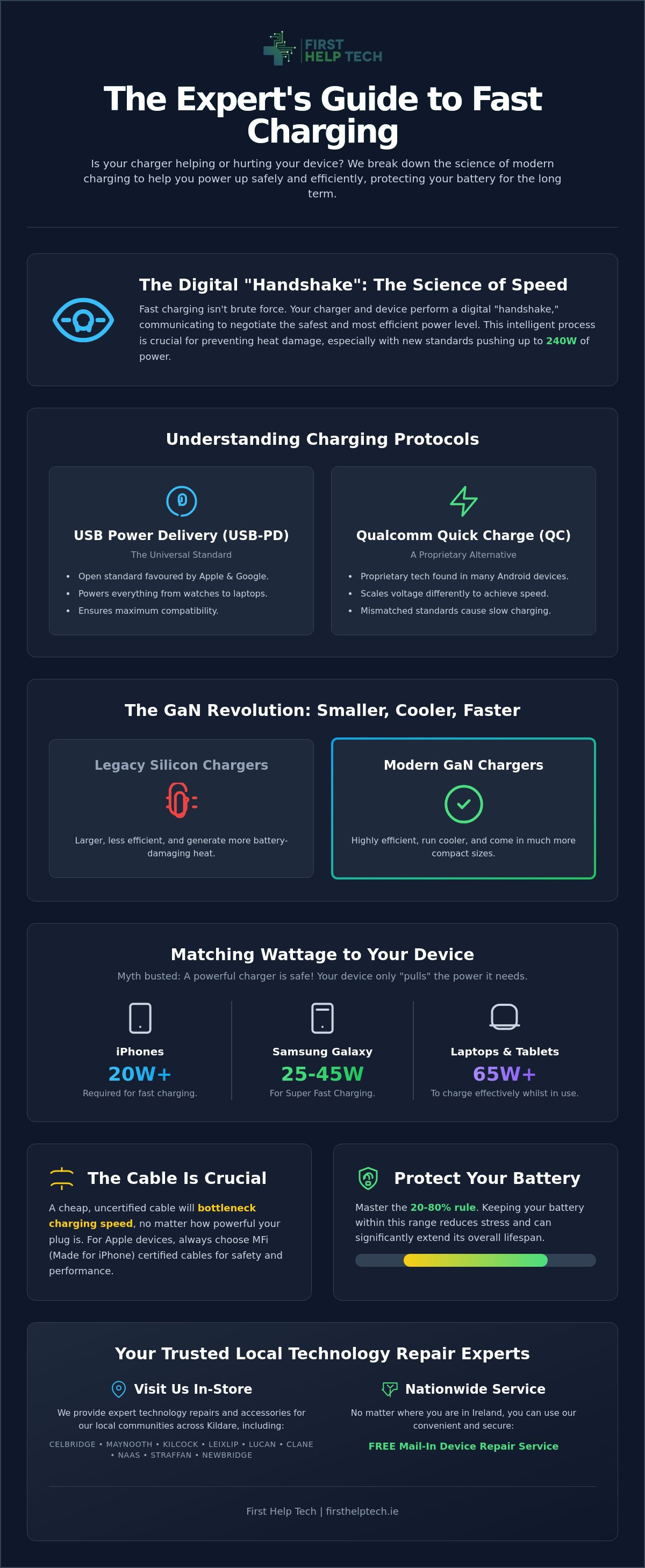
Fast charging isn't just about pushing more power into your phone. It's a smart, multi-stage process that increases voltage or amperage to transfer energy at high speeds. This isn't a brute-force delivery. Instead, your device and your fast charger perform a digital "handshake." They communicate instantly to agree on the safest maximum speed the battery can handle. With new 2026 standards allowing for up to 240W of power delivery, this negotiation is vital for preventing hardware damage and ensuring efficiency.
We provide expert technology repair for devices that fail to negotiate this handshake correctly. This often happens due to worn charging ports or faulty internal power chips. Whilst we are trusted local experts in Celbridge, Naas, and Maynooth, we see these issues from customers in Kilcock, Leixlip, and Lucan using our FREE Mail-In Device Repair Service. Whether you are based in Clane, Straffan, or Newbridge, we ensure your hardware is fully compatible with modern accessories.
USB Power Delivery (USB-PD) vs. Quick Charge (QC)
USB-PD is the open standard favoured by Apple and Google for universal compatibility. It allows a single plug to power everything from a smart watch to a high-end laptop safely. Qualcomm Quick Charge (QC) is a proprietary alternative that differs in how it scales voltage to achieve speed. While many modern plugs support both, using a mismatched standard often leads to "slow charging" notifications. We help our customers identify which protocol their specific device uses to ensure they get the fastest possible results without the guesswork.
The Role of Gallium Nitride (GaN) in Modern Chargers
Older chargers rely on silicon components, which get hot when handling high wattage. Modern fast charger designs now utilise Gallium Nitride (GaN) instead. This material conducts electrons more efficiently and survives higher voltages with less energy lost as heat. This efficiency allows manufacturers to create much smaller, more portable plugs that stay cool during use. By choosing GaN-based accessories, you're investing in tech that is better for your battery's longevity and much easier to carry in your daily bag.
Selecting the Right Fast Charger for Your Tech Collection
Choosing the perfect fast charger depends entirely on the specific devices in your kit. While modern standards are universal, wattage requirements vary significantly across different brands and hardware types. We always recommend matching your plug to your device's maximum intake to get the best performance for your money. If you find your device is still struggling to hold a charge after buying new accessories, you might need a professional mobile phone repairs specialist to check your battery health.
Organising your home or office charging centre with a multi-port adapter is a brilliant way to reduce clutter. These units allow you to power a laptop, phone, and tablet from a single wall socket. Whether you are at home in Celbridge or working from an office in Maynooth, having one reliable hub ensures all your gear stays ready for action. If you aren't sure which port to use, contact our team for expert advice on your specific setup.
Wattage and Compatibility: Why 20W, 25W, or 45W Matters
It's a common myth that a high-wattage plug will "fry" a smaller device. In reality, your smartphone only "pulls" the power it needs. You can safely use a 65W laptop plug for a phone that only supports 20W. To find your ideal match, use this quick checklist:
- iPhones: Require at least 20W for standard fast charging.
- Samsung Galaxy: Most models thrive on 25W, whilst Ultra variants often support up to 45W.
- Laptops and Tablets: Generally require 65W or more to charge whilst in use.
Essential Accessories for a Complete Charging Setup
The cable is just as important as the plug itself. A cheap, uncertified lead will often bottleneck your speed, regardless of how powerful your fast charger is. For Apple users, always look for MFi (Made for iPhone) certification to ensure consistent data and power transfer. Beyond just power, we also suggest looking at our guide on how to choose and apply the best screen protector to keep your device's exterior as healthy as its battery. From our shop in Kilcock to our customers in Leixlip and Lucan, we prioritise high-quality accessories that last.
If you are located further afield in Clane, Straffan, or Newbridge, don't forget you can access our professional technology repair expertise through our FREE Mail-In Device Repair Service. We make it simple to get your tech back in top condition without leaving your house; similarly, for those needing help on the road, you can visit Tyres at your door for mobile tyre repairs.
Maintaining Battery Health Whilst Using Fast Charging Technology
Many users worry that using a high-powered fast charger will wear out their battery prematurely. It’s a common misconception. The real enemy of your lithium-ion battery isn’t the speed of the electricity, but the heat generated during the power transfer. Modern devices are designed to manage this heat effectively, but you can help by keeping your handset on a cool, flat surface whilst it’s plugged in. Avoid charging on soft furnishings like beds or sofas, as these trap heat against the device's casing.
To truly maximise your battery's lifespan, we recommend following the 20-80% rule. Keeping your charge level between these two points reduces the chemical stress on the battery cells. If you notice your device is draining rapidly despite these efforts, it may be time for a professional battery replacement. We specialise in tablet repairs and smartphone battery services for all major brands across Ireland. For those living in Leixlip, Lucan, or further afield, our FREE Mail-In Device Repair Service makes getting a professional fix effortless and reliable.
Is Your Phone Not Charging? Troubleshooting Port Issues
Sometimes the issue isn't your fast charger at all. Dust, lint, or physical damage inside the charging port can prevent a solid connection and stop the "handshake" process we discussed earlier. Before you assume your accessories are faulty, try a few basic steps. We’ve put together a detailed guide on Phone Not Charging Repair Ireland to help you perform some quick DIY checks safely at home.
When to Seek Professional Technology Repair
If your device's screen is lifting or the back panel feels slightly "puffy," stop using it immediately. These are clear signs of battery swelling, which is a safety risk that no new cable can solve. Likewise, if your cable only works when held at a specific angle, your charging port likely requires a professional technology repair. We are your trusted local experts with a physical centre in Celbridge, Co. Kildare. We proudly serve our neighbours in Maynooth, Kilcock, and Straffan with fast, dependable solutions. Whether you need a simple port cleaning or a complex internal fix, we ensure your tech stays in peak condition.
Power Your Future with Confidence
Choosing the right fast charger is about more than just speed; it's about understanding the smart technology that keeps your hardware safe. By matching the correct wattage to your device and following the 20-80% charging rule, you're actively extending the lifespan of your favourite gadgets. These small choices make a massive difference to your daily tech experience whilst protecting your battery health for years to come.
We've been your trusted local technology repair experts since 2016, helping our community in Celbridge, Maynooth, and Naas stay connected. From our shop in Co. Kildare to our neighbours in Kilcock, Leixlip, and Lucan, we provide professional reassurance and expert advice. If you're based in Clane, Straffan, or Newbridge, or even further afield, our FREE Mail-In Device Repair Service ensures you can access our iPhone, Samsung, and iPad repair specialists from anywhere in Ireland. Don't let a faulty port or a tired battery slow you down. Explore our range of chargers and accessories or book a repair today to get your tech back to its best. We're ready to assist whenever you need us!
Frequently Asked Questions
Does fast charging ruin my smartphone battery over time?
Fast charging doesn't inherently ruin your battery; heat and chemical stress are the primary factors in degradation. Modern devices use sophisticated software to slow down charging once the battery reaches 80% to protect the internal cells. If your battery capacity has already dropped significantly or the device is behaving strangely, we offer professional battery replacements at our Celbridge centre in Co. Kildare or through our FREE Mail-In Device Repair Service.
Can I use a laptop fast charger to charge my mobile phone?
Yes, you can safely use a high-wattage laptop fast charger for your smartphone. Because of the USB Power Delivery (USB-PD) "handshake" protocol we discussed earlier, your phone will only draw the specific amount of power it can handle safely. This ensures your mobile device won't be overloaded even if the plug is rated for 100W or more. We see many customers in Naas and Newbridge successfully using one universal plug for all their gear.
Why does my device get warm whilst using a fast charger?
Your device gets warm because the process of converting high-voltage electricity into battery power is never 100% efficient. This lost energy is released as heat during the transfer. Whilst a gentle warmth is normal, excessive heat can indicate a failing battery or a damaged charging port. We provide expert technology repair for power issues to residents in Kilcock, Clane, and Straffan to keep their devices running safely and efficiently.
Do I need a specific USB-C cable for fast charging to work?
Yes, you must use a cable rated for the specific wattage of your fast charger to achieve maximum speeds. Standard cables often lack the necessary internal wiring or "e-marker" chips required to handle higher currents without overheating. For those in Lucan, Leixlip, or Maynooth looking for the right accessories, we always recommend using certified cables that match your plug's output to avoid bottlenecking your charging speed.