
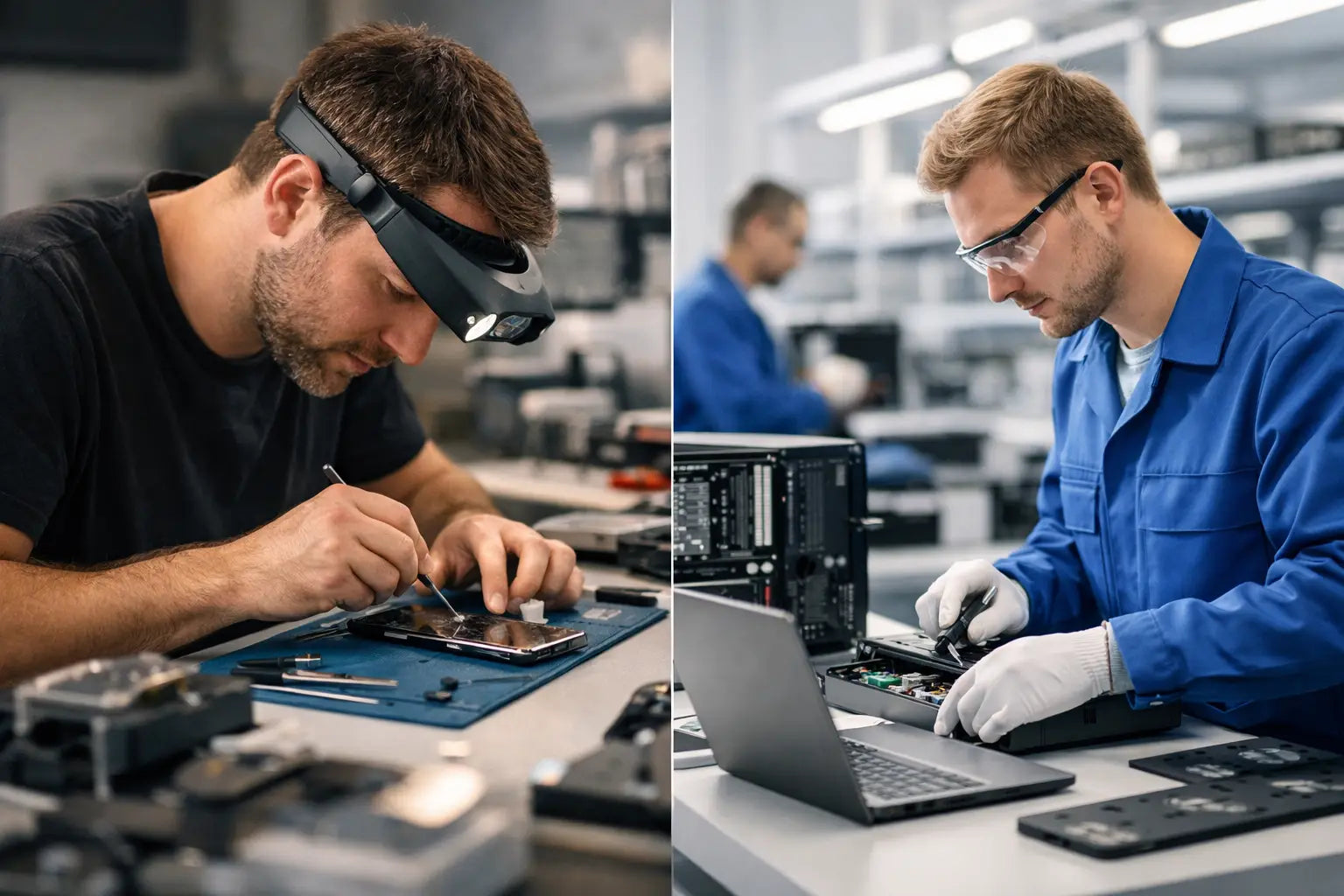
Your phone screen cracks on a Tuesday, your laptop battery gives up before Friday, and suddenly the question is not whether to fix it but where to take it. Independent repair vs manufacturer is usually a choice between speed, cost and convenience on one side, and brand-controlled processes on the other. Neither route is automatically better. The right answer depends on the device, the fault and how quickly you need your tech back.
For most people, this is a practical decision rather than a philosophical one. You want a repair that works, a price that makes sense, and as little disruption as possible. If you rely on your phone for banking, work messages, school runs and everything in between, being without it for a week is not a minor inconvenience.
Independent repair vs manufacturer for everyday issues
When people compare independent repair vs manufacturer, they are often dealing with common faults - cracked screens, worn batteries, charging port issues, camera problems or water damage. These are the jobs where the differences become obvious very quickly.
An independent repair shop often wins on speed. If parts are in stock, many repairs can be turned around the same day or within a short timeframe. That matters when your device is part of your daily routine. A manufacturer repair process can involve booking systems, shipping, assessment delays and queue times. That may be fine if you have a backup device. It is less fine if your only phone is currently unusable.
Cost is another major factor. Manufacturer repairs can be expensive, especially for older devices that are no longer under warranty. In some cases, the quoted repair cost gets close to the value of the device itself. Independent repair is often more affordable, which makes it a sensible option if you are trying to extend the life of a phone, tablet or laptop without overspending.
That said, manufacturer repair may appeal if your device is still under warranty or covered by a service plan. In that situation, going elsewhere could affect your coverage depending on the brand and the type of issue. It is always worth checking the terms before making a decision.
Where manufacturer repair makes more sense
There are times when the manufacturer is the safer call. If your device has a factory defect, a recall issue, or a fault clearly covered by warranty, using the official route is often the most straightforward option. You may get the repair done at reduced cost or no cost at all, and there is less room for debate over whether the brand will honour future support.
Manufacturer service can also make sense for newer or premium devices with highly restricted components. Some brands pair parts to the device in a way that affects performance or feature access after replacement. For example, certain biometric functions, display settings or system messages may behave differently depending on how the repair is carried out. If preserving every original function exactly as the brand intended is your top priority, official repair may be worth the extra cost and waiting time.
There is also a trust factor for some customers. A manufacturer repair feels familiar because it comes directly from the brand on the box. If that gives you more confidence, it is a valid reason. Peace of mind matters, especially for expensive devices.
Why many customers choose independent repair
Independent repair shops tend to be built around real-world convenience. You can ask questions, request a quote, compare options and often get a clearer idea of timescales before committing. That directness matters when you are trying to make a fast decision.
A good local repair business is also more likely to focus on whether the repair is actually worth doing. If the issue is minor, they may fix it quickly. If the device is too far gone or the cost does not stack up, they can tell you plainly instead of pushing you through a long process. That honest, practical advice is useful, especially for families, students and small business users trying to keep costs under control.
Independent repair also suits older devices better. Manufacturers naturally move their attention towards current models, but many people are still using phones and laptops that are two, three or four years old. If the device still does the job, replacing a battery or screen can be far better value than buying new. For that kind of repair, an experienced independent provider is often the more sensible route.
Parts, quality and the question everyone asks
One concern comes up every time: are the parts as good?
The honest answer is that quality varies, which is why choosing the repair provider matters as much as choosing between independent and manufacturer. Manufacturer repairs will generally use brand-controlled parts and approved processes. With independent repair, the standard depends on the business, the parts they source and the way they explain your options.
A trustworthy repair shop should be clear about part quality, expected performance and pricing. There is a difference between a budget-friendly repair option and a poor-quality one, and customers deserve to know what they are paying for. Transparency is a good sign. Vague answers are not.
This is also where reviews and reputation help. If a repairer consistently gets strong feedback for service, speed and results, that tells you more than a polished marketing line ever will. For many customers in Ireland, that local trust is a big part of the decision.
Turnaround time matters more than people think
It is easy to focus only on repair price, but downtime has a cost too. A phone being repaired for several days may mean missed work calls, difficulty accessing school apps, extra travel hassle or the need to buy a temporary replacement. A laptop away for a week can affect college assignments or business admin.
That is why independent repair often comes out ahead for day-to-day faults. Fast assessment, parts on hand and a simple booking process reduce friction. You are not just paying for the repair itself. You are paying to get your routine back.
For customers who need a practical option without the premium-brand delay, a local repair and accessories business can also solve more than one problem at once. You might get the screen replaced, pick up a case or charger, and leave with the device protected properly this time. That kind of convenience is hard to ignore.
Warranty, data and aftercare
Warranty is where the comparison needs a bit of care. If your device is under manufacturer warranty, always check what is covered before authorising any third-party repair. Sometimes the issue you are paying for could have been dealt with officially. Sometimes accidental damage is excluded anyway, which changes the calculation.
For out-of-warranty devices, the manufacturer advantage is often much smaller. At that point, you are mainly comparing price, time and trust.
Data is another concern. Whether you choose an independent repairer or the manufacturer, you should ask what the process involves and back up your device if possible. Some repairs do not affect data at all. Others may require resets, board work or more involved diagnostics. Clear communication is what matters.
Aftercare matters too. A good repair service should stand behind its work and explain what to expect after the job is done. If there are any limitations, risks or signs to watch for, you should hear that in plain language.
So, which option is actually better?
If your device is under warranty, has a known manufacturer fault, or you want official brand handling at any cost, the manufacturer may be the better fit.
If your priority is affordability, fast turnaround and practical support for a common issue, independent repair is often the better option. That is especially true for cracked screens, battery replacements, charging issues and older devices that still have plenty of life left in them.
The best choice is usually the one that matches the real value of the device and the urgency of the problem. A high-end phone less than six months old deserves a different approach from a three-year-old tablet used mainly for streaming and school apps. Treating every repair the same is how people end up overpaying.
For many customers, the smart move is simple: get the facts first. Ask about cost, turnaround time, part quality and warranty impact, then choose the route that gives you the best balance of value and peace of mind. If a trusted repair shop can sort the problem quickly and properly, there is no prize for making life harder than it needs to be.
When your device stops cooperating, the goal is not to win an argument between independent repair and the manufacturer. It is to get back to normal with the least hassle, the fairest price and a repair you can rely on.