
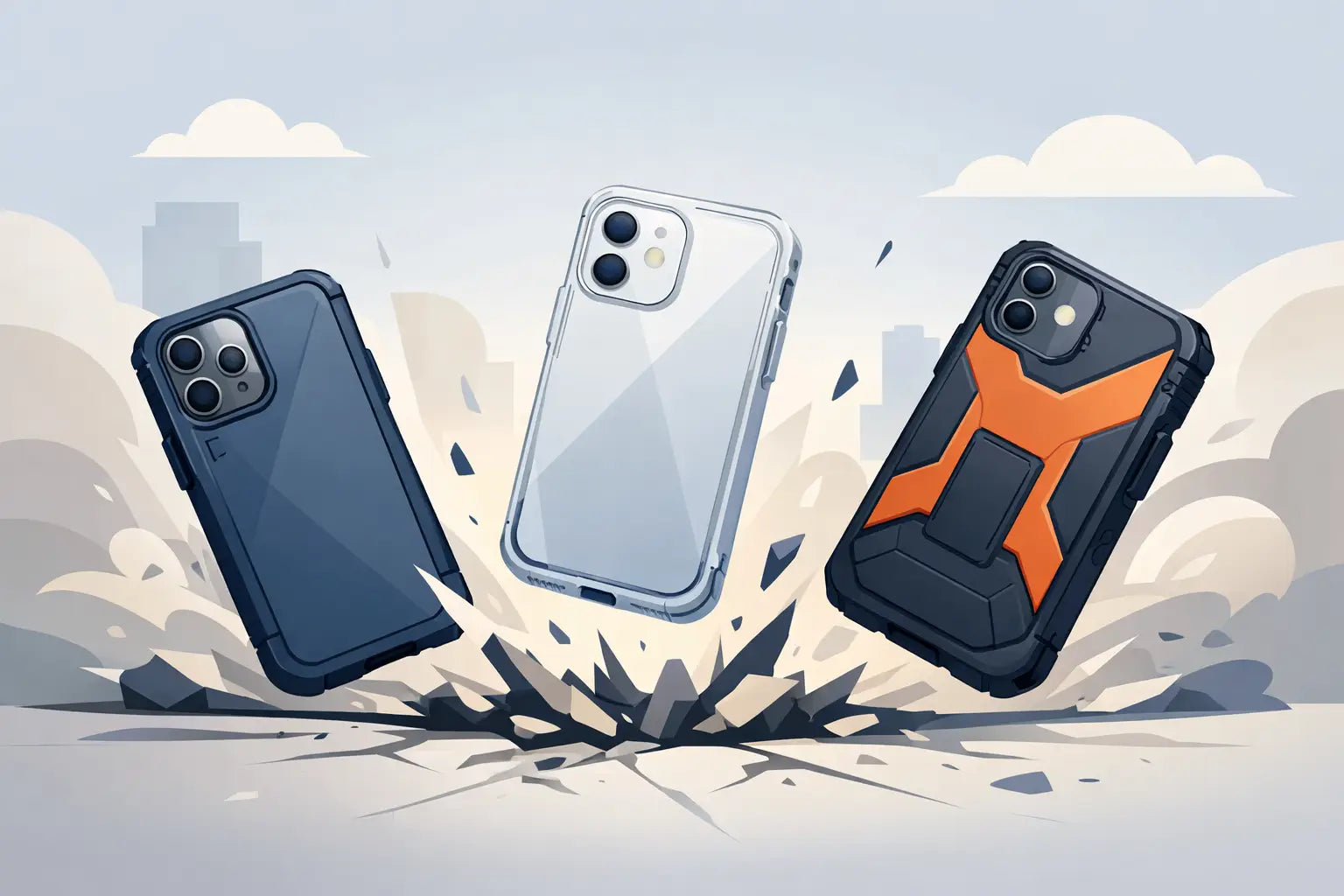
You only need one bad drop to turn a perfectly good phone into an expensive problem. That is why so many people look for the best phone cases for drops after the first cracked corner, smashed back glass or screen repair quote. The tricky bit is that not every bulky case protects well, and not every slim case is a waste of money. What matters is how the case handles impact, how you use your phone day to day, and whether it fits your device properly.
What actually makes the best phone cases for drops?
A good drop case does not just add thickness. It manages force. When a phone hits the ground, the energy has to go somewhere, and the case is there to absorb some of that shock before it reaches the frame, screen or rear glass.
That usually comes down to a few design details. Raised edges help keep the screen and camera from taking the first hit. Flexible materials such as TPU tend to absorb impact better than hard plastic on its own. Reinforced corners matter because corners are often the first point of contact in a fall. A secure fit matters too. Even a strong case is no use if it loosens around the edges after a few weeks.
You will also see drop-test claims on packaging. These can be helpful, but they are not the full story. A case tested from a certain height in lab conditions may still perform differently when your phone hits a pavement edge, kerb, tiled floor or concrete path at an awkward angle.
The main case types and how they compare
If you are shopping by price or by look alone, it is easy to buy the wrong thing. Most drop-protection cases fall into a few familiar categories.
Rugged cases
Rugged cases are the obvious choice for heavy protection. They are usually thicker, have reinforced corners, raised lips around the screen and camera, and a grippier outer finish. If you work on site, commute a lot, hand your phone to kids, or tend to drop it getting in and out of the car, this is often the safest option.
The trade-off is size. A rugged case adds bulk in your pocket or handbag, and some people simply stop using them because the phone feels too chunky. If the case is annoying enough to come off at home, it is not the right case.
Hybrid cases
Hybrid cases combine a softer shock-absorbing inner layer with a harder outer shell. For many people, this is the sweet spot. You get decent protection without turning the phone into a brick, and there is often better grip than with hard plastic alone.
If you want a practical everyday case rather than maximum bulk, this type is usually worth a look first.
Silicone and TPU cases
Soft silicone or TPU cases are common because they are affordable, light and comfortable to hold. Some are surprisingly good for everyday drops, especially if they have proper corner protection and raised edges. Others are very basic and offer little more than scratch protection.
This is where people often get caught out. A soft case can be protective, but only if it has enough structure. Thin, floppy covers may look neat, but they are not built for repeated impact.
Wallet and folio cases
Wallet cases add front protection, which can help if your phone lands face down. They are popular with users who want screen cover and card storage in one accessory. They can be a sensible option, especially for people who throw the phone into a bag with keys, coins or other hard items.
Still, not all folio cases are strong at the corners, and the front flap does not guarantee impact protection if the phone falls open or lands awkwardly. They are useful, but not always the best answer for frequent drops.
Clear protective cases
Clear cases are a common choice because people want to show off the phone colour while keeping it safe. The better versions use shock-absorbing materials and reinforced bumpers, so you do not always have to choose between looks and protection.
Just be careful with very cheap clear cases. Many go yellow over time, become slippery, or offer minimal side protection.
Best phone cases for drops by user type
The best choice depends less on the phone brand and more on how rough your day tends to be.
For students and commuters
If your phone spends half the day in a coat pocket, school bag or on a bus seat, go for a hybrid or medium-rugged case with raised edges and good grip. Slippery finishes are a poor match for rushing between classes or juggling coffee and a phone at the same time.
For parents
If children regularly borrow your phone, stronger corner protection matters more than a slim profile. A rugged case or a solid hybrid case is usually the safer buy. Spills, drops from sofas, kitchen counters and the odd throw across a room are more common than most parents would like.
For work use
If you are on the move, work outdoors, travel between jobs or use your phone on site, choose protection over style. Dust covers for ports can help, but the bigger priority is impact resistance and grip. A case that survives concrete is worth far more than one that looks tidy on a desk.
For everyday light use
If you rarely drop your phone and mostly use it at home, in the office or in the car, a slimmer TPU or hybrid case may be enough. The key is not going too thin. There is a big difference between slim and flimsy.
Features worth paying for
Not every premium feature is marketing fluff. A few are genuinely useful if drop protection is your priority.
Textured sides make a real difference. Many drops happen before impact protection even comes into play, simply because the phone slips in the hand. Extra grip can prevent the fall altogether.
Raised camera bezels are worth having, especially on newer phones with large camera modules. Rear glass and lens surrounds are expensive to repair, so keeping them off hard surfaces is sensible.
Responsive button covers matter more than people think. If buttons become stiff, users often remove the case or leave it partially unfastened. A proper fit keeps the protection consistent.
Screen protector compatibility is another one to check. A strong case and a decent screen protector work better together than either one alone.
What to avoid when buying a drop case
The cheapest option is not always the best value. If a bargain case stretches, cracks or loses shape quickly, you will replace it sooner and risk the phone in the meantime.
Cases that look protective but have open corners, loose sides or almost no screen lip are also worth skipping. The same goes for hard plastic shells with no softer impact layer. They may protect from scratches, but they are less forgiving in a real fall.
It is also worth being cautious with generic fits. A case made for your exact model should line up properly with the buttons, camera and ports. Poor fit usually means poor protection.
A case is only part of the protection
Even the best case cannot promise a perfect outcome every time. The angle of the drop, the height, the surface and the phone model all matter. Glass-backed phones are particularly vulnerable, and edge impacts can still cause damage through a strong case.
That is why the best setup is usually a proper case plus a screen protector. If your phone already has small cracks or frame damage, replacing the case alone will not fully solve the risk either. Existing weakness makes the next drop more serious.
If you are replacing a damaged case, do it quickly. Once the corners are split or the shell has gone loose, the protection is no longer what it was when new.
How to choose without overpaying
A lot of people assume the most expensive case must be the safest. Sometimes that is true, but not always. You are paying for a mix of brand name, design, finish and actual protection.
For most users, the best value sits in the middle. Look for a case with reinforced corners, raised edges, grippy sides and a proper model-specific fit. If it also works with wireless charging and does not make the phone awkward to use, even better.
If you drop your phone often, spend a bit more now. It is usually far cheaper than dealing with a cracked screen, damaged camera housing or back glass replacement later. If you hardly ever drop it, you can probably skip the heaviest rugged case and choose something more balanced.
At First Help Tech, this is the kind of practical choice we always encourage - buy for how you actually use the phone, not just how it looks in the packet.
The smart way to think about drop protection
The best phone case for drops is the one you will actually keep on your phone every day. That means enough protection for real life, without making the device so bulky or awkward that you leave the case off when it matters most. If you choose based on grip, corner protection, raised edges and proper fit, you will usually end up in a much better place than if you shop on looks alone.
A phone case cannot stop every accident, but the right one can turn a nasty drop into nothing more than a small fright.